
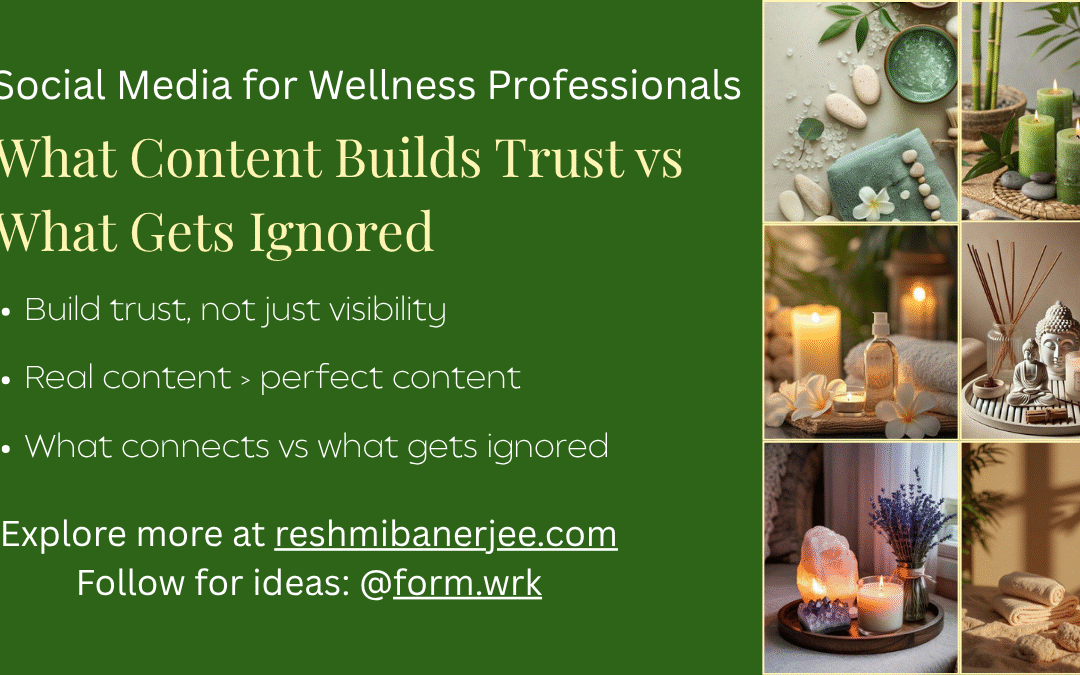
Social media for wellness professionals can feel overwhelming—especially when you’re trying to balance meaningful client work with the constant pressure to “show up” online.
If you’re a wellness professional, chances are you didn’t get into this work to become a “content creator.” You became a therapist, coach, yoga instructor, or healer to help people transform their lives—not to worry about algorithms, engagement rates, or what to post next.
And yet… social media is often the first place potential clients encounter you.
Here’s the challenge: most wellness content blends together. Inspirational quotes, generic tips, and perfectly curated images flood feeds—but very little of it actually builds trust. And in the wellness space, trust is everything.
This article breaks down what actually works in social media for wellness professionals, based on real-world client experience—not theory.
Contents
- 1 Why Trust Is Non-Negotiable in the Wellness Industry
- 2 Content That Builds Trust vs Content That Gets Ignored
- 3 Real-World Content Examples That Actually Work
- 4 Actionable Tips You Can Implement Immediately
- 5 A Note on Strategy vs Random Posting
- 6 Conclusion: Trust Is Your Greatest Marketing Asset
- 7 Ready to Elevate Your Content?
Why Trust Is Non-Negotiable in the Wellness Industry
Unlike selling products, wellness services are deeply personal. People aren’t just buying a session—they’re buying:
- Emotional safety
- Credibility
- Transformation
- A relationship
Whether someone is choosing a therapist or a nutritionist, they’re asking:
“Can I trust this person with my vulnerability?”
That’s why your wellness marketing strategy must go beyond visibility. You don’t just need reach—you need resonance.
From my experience working with service-based brands (and through projects showcased at https://reshmibanerjee.com/), the accounts that convert aren’t the most polished—they’re the most human.
Content That Builds Trust vs Content That Gets Ignored
Let’s get practical.
Here’s a clear breakdown of what works—and what doesn’t—in a content strategy for wellness brands.
✅ Content That Builds Trust
- Real Client Journeys (With Consent)
Share anonymized transformations:- “A client came to me struggling with burnout… here’s what shifted in 6 weeks.”
- Focus on process, not just results
- Behind-the-Scenes of Your Practice
Show your real work:- Preparing for a session
- Your journaling or meditation routine
- How you design a workshop
- Educational Content with Depth
Not “5 tips for stress”—but:- “Why your nervous system stays dysregulated (and what most people miss)”
- Break down concepts simply, but meaningfully
- Personal Stories (Boundaried, Not Overshared)
Talk about your journey:- Why you chose this path
- A challenge you overcame
- A lesson you learned working with clients
- Live Sessions & Interactive Content
- Q&A sessions
- Mini workshops
- Guided practices
- Values-Based Content
Take a stand:- “Why I don’t believe in quick-fix healing”
- “What toxic positivity gets wrong”
These forms of content help you build trust on social media because they show depth, experience, and authenticity.
❌ Content That Gets Ignored
- Generic Quotes
“You are enough.”
(Yes, it’s true—but it’s everywhere.) - Surface-Level Tips
“Drink water, sleep well, exercise.”
(No differentiation, no insight.) - Overly Polished, Stock-Like Content
Perfect visuals with zero personality often feel distant and unrelatable. - Constant Self-Promotion
“Book a session now!” repeated without context or value creates resistance. - Trend-Only Content Without Relevance
Jumping on trends that don’t align with your message confuses your audience. - Overcomplicated Language
Using jargon to sound “expert” often alienates potential clients.
Real-World Content Examples That Actually Work
Let’s bring this to life with examples I’ve seen perform consistently well:
1. The “Session Insight” Post
A therapist shares:
“Something I noticed this week: many clients aren’t actually afraid of failure—they’re afraid of being seen trying.”
This kind of post:
- Feels real
- Reflects experience
- Sparks self-reflection
2. The “Workshop Breakdown” Reel
A yoga instructor shows:
- Clips from a breathwork workshop
- Voiceover explaining the intention behind each practice
This builds credibility without directly selling.
3. The “Before/After Mindset Shift”
A coach shares:
- Before: “I need to be perfect to be accepted”
- After: “I can be seen even when I’m still growing”
No dramatic claims—just relatable transformation.
4. The “Unpopular Truth” Post
A nutritionist shares:
“Healing your relationship with food isn’t about willpower—it’s about safety.”
This positions them as thoughtful and differentiated.
Actionable Tips You Can Implement Immediately
Let’s turn strategy into action.
1. Replace “Posting” with “Documenting”
Instead of asking:
“What should I post today?”
Ask:
“What did I learn from my work this week?”
Your best content is already happening inside your practice.
2. Use the 70/20/10 Content Mix
A practical framework I use with clients:
- 70% Trust-building content (education, stories, insights)
- 20% Connection content (personal, behind-the-scenes)
- 10% Promotion
This keeps your audience engaged without feeling sold to.
3. Write Like You Speak to Clients
Avoid sounding like a textbook.
Instead of:
“Individuals often experience emotional dysregulation…”
Say:
“Ever feel overwhelmed for no clear reason? Here’s what might be happening.”
Clarity builds trust faster than complexity.
4. Create “Save-Worthy” Content
Focus on depth over virality.
Ask:
- Would someone save this for later?
- Does this make them feel understood?
That’s how you win long-term.
5. Show Your Thought Process
Don’t just give answers—show how you think.
For example:
- Why you recommend certain practices
- What you don’t agree with in your industry
This positions you as an authority, not just a content creator.
6. Be Consistent with Your Voice, Not Just Posting
You don’t need to post daily—but you do need to sound like you every time.
Consistency in tone builds familiarity. Familiarity builds trust.
A Note on Strategy vs Random Posting
One of the biggest shifts I see when working with wellness professionals is this:
They move from “What should I post?” to
→ “What do I want to be known for?”
That’s the foundation of a strong content strategy for wellness brands.
If you’re serious about growing your presence, studying real examples and strategic frameworks—like those shared at https://reshmibanerjee.com/—can help you move from guesswork to intentional growth.
Conclusion: Trust Is Your Greatest Marketing Asset
In the wellness industry, your content isn’t just content—it’s your first session with a potential client.
The accounts that grow sustainably aren’t the loudest or trendiest. They’re the ones that:
- Show real experience
- Speak with clarity
- Create emotional safety
If you focus on that, your audience won’t just follow you—they’ll trust you.
And trust is what converts.
Ready to Elevate Your Content?
If you’re looking for fresh, thoughtful, and creative inspiration, explore content ideas that actually connect—not just perform.
Check out this Instagram page for inspiration:
https://www.instagram.com/form.wrk?igsh=MWhnaDU0ZjQwbXBqeA==
It’s a great starting point to see how intentional content can feel both strategic and authentic.
Because your work deserves to be seen—and trusted.